<?xml version="1.0" encoding="utf-8"?><feed xmlns="http://www.w3.org/2005/Atom" ><generator uri="https://jekyllrb.com/" version="4.4.1">Jekyll</generator><link href="https://curl.group/feed.xml" rel="self" type="application/atom+xml" /><link href="https://curl.group/" rel="alternate" type="text/html" /><updated>2026-03-11T17:38:37+01:00</updated><id>https://curl.group/feed.xml</id><title type="html">CURL</title><subtitle>Research Group</subtitle><author><name>Chris Ringeval</name></author><entry><title type="html">Cosmology Seminar</title><link href="https://curl.group/news/2026/03/09/seminar.html" rel="alternate" type="text/html" title="Cosmology Seminar" /><published>2026-03-09T08:00:00+01:00</published><updated>2026-03-09T08:00:00+01:00</updated><id>https://curl.group/news/2026/03/09/seminar</id><content type="html" xml:base="https://curl.group/news/2026/03/09/seminar.html"><![CDATA[<p>The next cosmology seminar takes place on <strong>Friday 13th</strong> of March,
<strong>room E349</strong> at <strong>2:00pm</strong>. We will have the pleasure to listen to
<strong>Pierre Auclair</strong> from the Institut d’Astrophysique de Paris (IAP, France).</p>

<p>At 2:00pm, room E349, <strong>Pierre Auclair</strong> will be talking about</p>

<h3 id="excursion-set-for-primordial-black-holes-white-noise-and-moving-barrier">Excursion-set for Primordial Black Holes: white noise and moving barrier</h3>

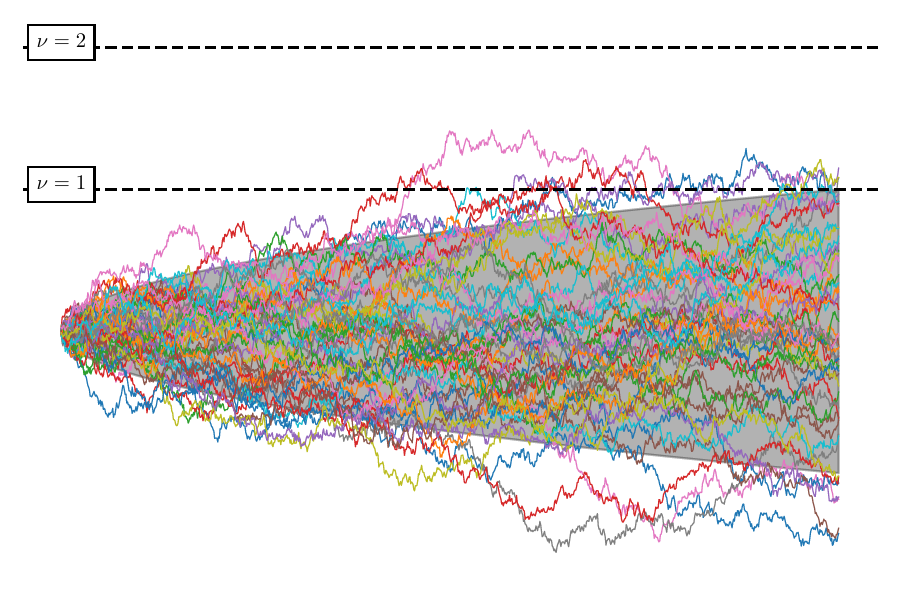
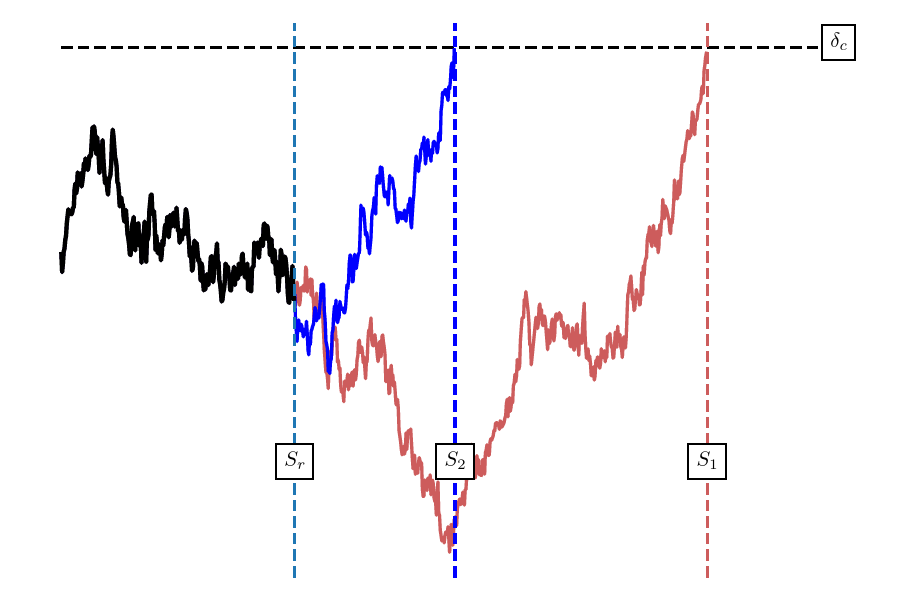
<p><em>I will introduce pedagogically the Excursion-Set formalism, a
framework in which the mass distribution of primordial black holes
(PBHs) is derived from the first-passage time of a random walk
describing the density contrast as the coarse-graining scale varies.
In particular, I will address in detail two recent criticisms/remarks
that have been raised about this approach. First, it was argued that
the random walks are subject to colored (i.e. correlated over time)
noise, making the first-passage-time problem cumbersome. We show that
this arises from an incorrect separation of drift and noise when
sampling on the Hubble-crossing surface: if Fourier modes are
uncorrelated, the noise is strictly white. Moreover, sampling along
the Hubble-crossing surface precludes using the density dispersion as
a time variable, explaining the reported pathologies. Sampling instead
on a synchronous surface removes both issues. This requires solving a
first-passage-time problem with a moving barrier, for which we provide
an efficient numerical framework. Second, it was suggested that
cloud-in-cloud (i.e. that large black holes may engulf smaller ones)
is irrelevant for PBHs and that the excursion set is therefore not
needed. While valid for widely separated scales, this statement fails
for broad power spectra with enhanced continua of modes. We further
show that Press-Schechter estimates neglecting boundary evolution can
break down even without cloud-in-cloud effects <a class="citation" href="#auclair:2026tfy">[1]</a>.</em></p>]]></content><author><name>Chris Ringeval</name></author><category term="News" /><summary type="html"><![CDATA[The next cosmology seminar takes place on Friday 13th of March, room E349 at 2:00pm. We will have the pleasure to listen to Pierre Auclair from the Institut d’Astrophysique de Paris (IAP, France).]]></summary></entry><entry><title type="html">Gravitational waves from stiff periods</title><link href="https://curl.group/news/2025/12/01/2511.08384.html" rel="alternate" type="text/html" title="Gravitational waves from stiff periods" /><published>2025-12-01T08:00:00+01:00</published><updated>2025-12-01T08:00:00+01:00</updated><id>https://curl.group/news/2025/12/01/2511.08384</id><content type="html" xml:base="https://curl.group/news/2025/12/01/2511.08384.html"><![CDATA[<p>In a recent publication, <a href="/members/tomberg"><strong>Eemeli</strong></a> and collaborators
have studied the observability of stiff periods of decelerated
expansion in the early history of the universe.</p>

<p>There are reasons to believe the early Universe was dominated by a
scalar field which caused space to expand in an accelerating
manner. After this <a href="https://en.wikipedia.org/wiki/Cosmic_inflation"><strong>Cosmic
Inflation</strong></a>, the
scalar field was replaced by radiation consisting of <a href="https://en.wikipedia.org/wiki/Standard_Model"><strong>Standard
Model</strong></a> particles. The
subsequent radiation-dominated era is well understood. For example,
the nuclei of light elements were born during it through the process
of Big Bang Nucleosynthesis
(<a href="https://en.wikipedia.org/wiki/Big_Bang_nucleosynthesis"><strong>BBN</strong></a>). Theoretical
computations of BBN match very well the observed late-time abundances
of these elements (with the possible exception of
<a href="https://en.wikipedia.org/wiki/Cosmological_lithium_problem">lithium</a>). Hence,
by BBN, the Universe must have settled to the standard
radiation-dominated behaviour, and any exotic ingredients beyond the
Standard Model must have vanished or become negligible. However, the
era between inflation and BBN is less constrained, and exotic
processes may have taken place there.</p>

<p>It is, in fact, possible that scalar fields may have dominated the
Universe for some time even after the end of inflation. This happens
in models of <em>quintessential inflation</em>, where the scalar field
responsible for inflation sticks around and later comes to play the
role of dark energy, causing the Universe to inflate again at late
times. Right after the primordial inflation, the scalar field
typically undergoes <em>kination</em>, motion dominated by the scalar’s
kinetic energy. A long period of kination leaves a mark: it amplifies
gravitational waves born during inflation. This has a two-fold
effect. First, the amplified gravitational waves may become detectable
in future gravitational wave observatories. Second, the gravitational
waves may break the delicate balance of BBN, producing wrong ratios of
light elements and making the model unviable.</p>

<p>The second effect tends to kick in before the first: observationally
interesting models are ruined by their inability to abide by the BBN
bound. In Ref. <a class="citation" href="#brissenden:2025ass">[1]</a>,
<a href="/members/tomberg"><strong>Eemeli</strong></a> worked together with <a href="https://www.lancaster.ac.uk/physics/about-us/people/konstantinos-dimopoulos"><strong>Konstantinos
Dimopoulos</strong></a>
and <a href="https://inspirehep.net/authors/2621653"><strong>Lucy Brissenden</strong></a> from
Lancaster University to show that there is a class of kination models
that respects the BBN bound but is still detectable by future
gravitational wave experiments. The trick is to make the transition
from inflation kination (called a ‘stiff’ period) ‘soft,’ so that the
Universe’s equation of state changes slowly during this era. The
effect on the gravitational wave spectrum is depicted in the following
figure:</p>

<p><img src="/assets/images/2511.08384/spectrum.png" alt="spectrum" title="Gravitational wave spectrum and the sensitivities of experiments" /></p>

<p>The colored curves represent the sensitivities of current and future
gravitational wave (and other) experiments for various gravitational
wave frequencies. BBN sets a universal limit on the gravitational wave
spectrum across all frequencies. The semi-vertical lines are two
example spectra, one with standard kination (dashed blue) and one with
a soft transition period (purple). The standard case increases steeply
all the way to the highest frequencies, narrowly avoiding the BBN
bound, but also missing most of the gravitational wave detectors’
sensitivities. The soft case has a rounded top (corresponding to the
soft period), again avoids the BBN, but this time also hits the
sensitivities of the <a href="https://en.wikipedia.org/wiki/Einstein_Telescope"><strong>Einstein
Telescope</strong></a> (ET)
and the <a href="https://en.wikipedia.org/wiki/Cosmic_Explorer_(gravitational_wave_observatory)"><strong>Cosmic
Explorer</strong></a>
(CE). The maximum frequency for both curves is approximately fixed by
the energy scale of inflation, which is here set to the highest
observationally allowed value, since this also produces the highest
gravitational wave density.</p>

<p>The soft period in <a class="citation" href="#brissenden:2025ass">[1]</a> was produced by a
double-exponential scalar potential motivated by string theory. With
only a little tuning, the model produces both detectable gravitational
waves and the correct dark energy behaviour at late times. The model
also satisfies other necessary constraints, such as the requirement
for the scalar field itself to be sufficiently suppressed during
BBN. It paves the way for other models that can produce similar
effects.</p>]]></content><author><name>Chris Ringeval</name></author><category term="News" /><summary type="html"><![CDATA[In a recent publication, Eemeli and collaborators have studied the observability of stiff periods of decelerated expansion in the early history of the universe.]]></summary></entry><entry><title type="html">Prmordial black holes from spiky perturbations</title><link href="https://curl.group/news/2025/11/28/2510.09303.html" rel="alternate" type="text/html" title="Prmordial black holes from spiky perturbations" /><published>2025-11-28T08:00:00+01:00</published><updated>2025-11-28T08:00:00+01:00</updated><id>https://curl.group/news/2025/11/28/2510.09303</id><content type="html" xml:base="https://curl.group/news/2025/11/28/2510.09303.html"><![CDATA[<p><a href="/members/tomberg.html"><strong>Eemeli</strong></a> has studied the formation of primordial
black holes from inflationary perturbations together with
collaborators from the University of Helsinki.</p>

<p>As discussed in, for example,
<a href="/news/2025/09/01/2507.15522.html">here</a>, cosmic
inflation is an early era during which a scalar field makes the
Universe expand extremely fast. Small ripples in the field can get
amplified, so that some patches of space end up with more matter than
others when inflation ends. If the extra matter is compact enough, it
collapses into a <strong>primordial black hole</strong>. Computing the black hole
statistics from a given model of inflation is an active field of
study.</p>

<p>Compactness of matter is measured with the <strong>compaction function</strong>
\(\mathcal{C}\), the extra mass \(\Delta M\) in a given patch of space
divided by the patch’s radius \(R\). To see if a black hole forms
around a given point in space, we can compute the compaction function
for many patches of varying radii around the point. These give the
radial profile of the compaction function. The profile goes to zero
for small and large radii (where \(\Delta M\) becomes small and \(R\)
becomes large, respectively), but may have a high peak at intermediate
scales. If the peak is high enough, it triggers black hole
collapse. The radius at the peak gives the black hole’s mass.</p>

<p>The compaction function is tricky to compute from models of inflation;
indeed, usually cosmologists like to work with another perturbation
quantity, the <em>curvature perturbation</em> \(\zeta\). The two quantities
are related but not identical: the compaction function is related to
the curvature perturbation’s radial derivative. It is commonly assumed
that a high curvature perturbation corresponds to a high compaction
function, so that the curvature perturbation can be used to estimate
the abundance of primordial black holes. In Ref. <a class="citation" href="#raatikainen:2025gpd">[1]</a>, together with <a href="https://www.mv.helsinki.fi/home/syrasane/"><strong>Syksy
Räsänen</strong></a> and <a href="https://en.wikipedia.org/wiki/Sami_Raatikainen"><strong>Sami
Raatikainen</strong></a> from
the University of Helsinki, Eemeli has shown that this is not always
the case.</p>

<p>In Ref. <a class="citation" href="#raatikainen:2025gpd">[1]</a>, the authors performed a
numerical study of inflationary perturbations using the method of
<strong>stochastic inflation</strong> (for more on stochastic inflation, see these
posts: <a href="/news/2025/09/01/2507.15522.html">arXiv:2507.15522</a>, <a href="/news/2025/05/16/2504.17680.html">arXiv:2504.17680</a>, and <a href="/news/2025/01/29/2501.05371.html">arXiv:2501.05371</a>. With Finnish supercomputers, they built \(10^8\) radial
perturbation profiles in three typical single-field primordial black
hole models. The study is the first one to construct the full radial
profiles; previous studies have been limited to studying the
perturbations only at fixed length scales. This was achieved through a
Fourier transform of over 10 000 correlated momentum shells, revealing
the full correlations between different radii. Interestingly, the
compaction profiles turned out to be very spiky, with sharp dips up
and down instead of wide, smooth peaks. The figure below shows an
example case: on the left, the curvature perturbation profile, and on
the right, the corresponding compaction function profile (together
with various estimates; for details, see Ref. <a class="citation" href="#raatikainen:2025gpd">[1]</a>).</p>

<p><img src="/assets/images/2510.09303/profiles.png" alt="potential" title="Example profiles of curvature perturbation (left) and compaction function (right)" /></p>

<p>Previous studies have mainly used the curvature perturbation amplitude
as a criterion for black hole formation. The statistics of the radial
profiles show, however, that the maximum amplitudes of the compaction
function and the curvature perturbation are not very strongly
correlated, see the figure below:</p>

<p><img src="/assets/images/2510.09303/correlation.png" alt="potential" title="Correlation between the maximum curvature perturbation and compaction function" /></p>

<p>Previous work has argued that black hole abundance is enhanced by
non-perturbative effects that modify the curvature perturbation
distribution, giving it an exponential tail. The results of <a class="citation" href="#raatikainen:2025gpd">[1]</a>
indicate that the spikiness of the profiles has an even larger effect
on the abundance, increasing it by many orders of magnitude compared
to previous estimates. The compaction function spikes rise well over
typical mean profiles deduced from the curvature perturbation
amplitude, forming black holes even in cases where the curvature
perturbation stays small. As a consequence, the curvature perturbation
spectrum required to form abundant black holes is smaller than
previously assumed, of order 0.001 by a preliminary estimate. Since
the spikes can form at many different scales, the black hole mass
distribution becomes wide, as shown below. Such a wide distribution
may clash with observational constraints.</p>

<p><img src="/assets/images/2510.09303/masses.png" alt="potential" title="Example mass distribution" /></p>

<p>The results of <a class="citation" href="#raatikainen:2025gpd">[1]</a> come with caveats. The
collapse threshold used in this work is based on earlier numerical
relativity simulations, which consider gravitational collapse starting
from smooth profiles. The narrow and spiky compaction function peaks
found here are quite different, and new collapse simulations are needed to
see how this affects the collapse threshold. The wide mass
distributions also suffer from convergence issues, and it is possible
that the large-scale peaks get wiped out by cosmological evolution
before they have time to collapse into black holes. More work is
needed extract all information from the spiky perturbation profiles.</p>]]></content><author><name>Chris Ringeval</name></author><category term="News" /><summary type="html"><![CDATA[Eemeli has studied the formation of primordial black holes from inflationary perturbations together with collaborators from the University of Helsinki.]]></summary></entry><entry><title type="html">Cosmology Seminar</title><link href="https://curl.group/news/2025/11/12/seminar.html" rel="alternate" type="text/html" title="Cosmology Seminar" /><published>2025-11-12T14:00:00+01:00</published><updated>2025-11-12T14:00:00+01:00</updated><id>https://curl.group/news/2025/11/12/seminar</id><content type="html" xml:base="https://curl.group/news/2025/11/12/seminar.html"><![CDATA[<p>The next cosmology seminar takes place on <strong>Wednesday 19th</strong> of November,
<strong>room E349</strong> at <strong>2:00pm</strong>. We will have the pleasure to listen to
Prof. <strong>Tomo Takahashi</strong> from Saga University (Japan).</p>

<p>At 2:00pm, room E349, <strong>Tomo Takahashi</strong> will be talking about</p>

<h3 id="more-fields-are-different-stochastic-view-of-multi-field-inflationary-scenario">More fields are different: Stochastic view of multi-field inflationary scenario</h3>

<p><em>High-energy physics often motivates multi-field inflationary
scenarios where stochastic effects play a crucial role. Peculiar to
multi-field models, the noise-induced centrifugal force results in a
longer duration of inflation depending on the number of fields, even
when the stochastic noises themselves are small. We show that, in
such small-noise regimes, the number of fields generically
discriminates whether inflation successfully terminates or lasts
forever. Our results indicate that inflation with an extremely large
number of fields may fail to realise our observable Universe.</em></p>]]></content><author><name>Chris Ringeval</name></author><category term="News" /><summary type="html"><![CDATA[The next cosmology seminar takes place on Wednesday 19th of November, room E349 at 2:00pm. We will have the pleasure to listen to Prof. Tomo Takahashi from Saga University (Japan).]]></summary></entry><entry><title type="html">Cosmology Seminar</title><link href="https://curl.group/news/2025/11/07/seminar.html" rel="alternate" type="text/html" title="Cosmology Seminar" /><published>2025-11-07T14:00:00+01:00</published><updated>2025-11-07T14:00:00+01:00</updated><id>https://curl.group/news/2025/11/07/seminar</id><content type="html" xml:base="https://curl.group/news/2025/11/07/seminar.html"><![CDATA[<p>The next cosmology seminar takes place on <strong>Friday 14th</strong> of November,
<strong>room E349</strong> at <strong>2:00pm</strong>. We will have the pleasure to listen to
<strong>Lisa Mickel</strong> from the Institut d’Astrophysique de Paris (IAP, France).</p>

<p>At 2:00pm, room E349, <strong>Lisa Mickel</strong> will be talking about</p>

<h3 id="trajectories-for-a-superposition-quantum-universe">Trajectories for a superposition quantum universe</h3>

<p><em>In the quest to establish possible imprints of quantum gravity one
can quantise the reduced FLRW phase space to obtain so-called
minisuperspace models that should be understood as a low energy limit
of a full quantum gravitational theory. For a minisuperspace model
that uses a perfect fluid as internal time and an affine quantisation
procedure one finds solutions for the wave function that correspond to
bouncing universes, thus resolving the big bang singularity. Starting
from such a bouncing minisuperspace model we will relax the assumption
that the state of the quantum universe has to correspond to a single
highly semiclassical state. Instead, we will consider a universe in a
superposition of such states, in accordance with the superposition
principle of quantum mechanics.
We are then faced with the question of how to extract a semiclassical
scale factor that can be connected to the classical evolution of GR
from such a system. Here we propose to make use of the trajectory
approach to quantum mechanics, which assigns a unique value to the
scale factor at all times.  We introduce this approach to quantum
mechanics more generally and show how it can be used to describe a
single state universe, before continuing to investigate trajectories
obtained for the case of a biverse (superposition of two semiclassical
states). These trajectories exhibit features that significantly differ
from the single state case.  Finally, we illustrate the treatment of
tensor perturbations on a background given by a biverse trajectory and
consider the implications of the existence of such a trajectory for
the evolution of perturbations.</em></p>]]></content><author><name>Chris Ringeval</name></author><category term="News" /><summary type="html"><![CDATA[The next cosmology seminar takes place on Friday 14th of November, room E349 at 2:00pm. We will have the pleasure to listen to Lisa Mickel from the Institut d’Astrophysique de Paris (IAP, France).]]></summary></entry><entry><title type="html">Cosmology Seminar++</title><link href="https://curl.group/news/2025/10/14/seminar.html" rel="alternate" type="text/html" title="Cosmology Seminar++" /><published>2025-10-14T09:00:00+02:00</published><updated>2025-10-14T09:00:00+02:00</updated><id>https://curl.group/news/2025/10/14/seminar</id><content type="html" xml:base="https://curl.group/news/2025/10/14/seminar.html"><![CDATA[<p>The second cosmology seminar of the week takes place on <strong>Friday 31st</strong> of October,
<strong>room E349</strong> at <strong>2:00pm</strong>. We will have the pleasure to listen to
<strong>José Beltrán Jiménez</strong> from the Gravitation and Cosmology Group, University of Salamanca (Spain).</p>

<p>At 2:00pm, room E349, <strong>José Beltrán Jiménez</strong> will be talking about</p>

<h3 id="electromagnetically-k-mouflaged-dark-matter-and-the-ladder-symmetries-of-screened-objects">Electromagnetically K-mouflaged dark matter and the ladder symmetries of screened objects</h3>

<p><em>I will discuss a cosmological scenario where dark matter is provided
with a dark electric charge with a dark electromagnetic sector
featuring a screening mechanism so that all the effects only appear at
low redshift, when dark matter is sufficiently clustered. Within these
models, it is natural to have a universe described by a Lemaitre model
instead of a FLRW. Instead of solving the full relativistic equations,
I will consider a Newtonian approach that is sufficient for a matter
dominated universe with, possibly, a cosmological constant. In this
scenario, it is possible to explain the Hubble tension in terms of the
dark electric repulsion between dark matter halos. After reviewing
some phenomenological consequences, I will proceed to analysing the
deformability of dark matter haloes due to the dark electromagnetic
interaction and show the emergence of a curious 2-ladder structure
connecting different multipoles for the case of Born-Infeld
electromagnetism. Furthermore, some multipoles exhibit a vanishing
polarisability or magnetisation, thus showing an intriguing
resemblance with the vanishing of the Love numbers of black
holes. Finally, I will explain how analogous results arise for the
scalar DBI theories in arbitrary dimensions and some finite size
effects.</em></p>]]></content><author><name>Chris Ringeval</name></author><category term="News" /><summary type="html"><![CDATA[The second cosmology seminar of the week takes place on Friday 31st of October, room E349 at 2:00pm. We will have the pleasure to listen to José Beltrán Jiménez from the Gravitation and Cosmology Group, University of Salamanca (Spain).]]></summary></entry><entry><title type="html">Cosmology Seminar</title><link href="https://curl.group/news/2025/10/13/seminar.html" rel="alternate" type="text/html" title="Cosmology Seminar" /><published>2025-10-13T09:00:00+02:00</published><updated>2025-10-13T09:00:00+02:00</updated><id>https://curl.group/news/2025/10/13/seminar</id><content type="html" xml:base="https://curl.group/news/2025/10/13/seminar.html"><![CDATA[<p>The next cosmology seminar takes place on <strong>Thursday 30th</strong> of October,
<strong>room E349</strong> at <strong>11:00am</strong>. We will have the pleasure to listen to
<strong>José Beltrán Jiménez</strong> from the Gravitation and Cosmology Group, University of Salamanca (Spain).</p>

<p>At 11:00am, room E349, <strong>José Beltrán Jiménez</strong> will be talking about</p>

<h3 id="the-cosmological-principle-its-non-trivial-realisations-with-some-phenomenological-consequences">The Cosmological Principle: its non-trivial realisations with some phenomenological consequences</h3>

<p><em>The Cosmological Principle is one of the pillars of the standard
 model of cosmology and it is commonly realised in a trivial way with
 homogeneous SO(3)-scalars. I will discuss several scenarios where the
 matter sector realises the Cosmological Principle in a non-trivial
 manner by resorting to combinations of spacetime and internal
 symmetries. These scenarios include the effective field theory of
 fluids and solids (as well as their dual formulations), but more
 general setups based on e.g. vector fields with internal
 symmetries. A natural consequence of some of these scenarios is the
 appearance of a second helicity-2 mode in the cosmological
 perturbations that produces oscillations of gravitational waves with
 distinctive signatures. I will also discuss some intriguing
 realisations that occur on shell and lead to the possibility of
 having preferred directions in an exactly isotropic background
 universe.</em></p>]]></content><author><name>Chris Ringeval</name></author><category term="News" /><summary type="html"><![CDATA[The next cosmology seminar takes place on Thursday 30th of October, room E349 at 11:00am. We will have the pleasure to listen to José Beltrán Jiménez from the Gravitation and Cosmology Group, University of Salamanca (Spain).]]></summary></entry><entry><title type="html">Eternal inflation near inflection points</title><link href="https://curl.group/news/2025/09/01/2507.15522.html" rel="alternate" type="text/html" title="Eternal inflation near inflection points" /><published>2025-09-01T09:00:00+02:00</published><updated>2025-09-01T09:00:00+02:00</updated><id>https://curl.group/news/2025/09/01/2507.15522</id><content type="html" xml:base="https://curl.group/news/2025/09/01/2507.15522.html"><![CDATA[<p>In collaboration with <a href="https://www.lancaster.ac.uk/physics/about-us/people/konstantinos-dimopoulos"><strong>Konstantinos
Dimopoulos</strong></a>
from the University of Lancaster, <a href="/members/tomberg.html"><strong>Eemeli</strong></a> has
studied the possibility of eternal inflation in models that produce
primordial black holes.</p>

<p><a href="https://en.wikipedia.org/wiki/Cosmic_inflation"><strong>Cosmic inflation</strong></a>
is a period of accelerated expansion of space which likely took place
in the very early universe. The expansion is driven by the inflaton, a
scalar field that undergoes random motion due to quantum effects. This
random motion shows up as inhomogeneities in the late universe,
seeding cosmic structure such as galaxies and galaxy groups. If the
inhomogeneities are particularly strong at short scales, they may form
structures even before galaxy formation, collapsing straight into
<a href="https://en.wikipedia.org/wiki/Primordial_black_hole"><strong>primordial black holes</strong></a>. Such
black holes would be dark matter and would radiate gravitational waves
that could be observable by gravitational wave detectors.</p>

<p>A popular way to produce the strong inhomogeneities needed for black
hole formation is to give the inflaton an inflection point potential
with a local bump (see figure). As the inflaton climbs over the bump,
it slows down, so the quantum fluctuations can have a stronger
relative effect. Besides black holes, such strong quantum effects may
lead to another phenomenon: <a href="https://en.wikipedia.org/wiki/Eternal_inflation"><strong>eternal
inflation</strong></a>. In
eternal inflation, quantum kicks oppose classical forces enough to
keep the inflaton near the bump eternally in some regions of space.</p>

<p><img src="/assets/images/2507.15522/potential.png" alt="potential" title="Example inflation point potential" /></p>

<p>To test if inflation is eternal in primordial black hole models, in
Ref. <a class="citation" href="#tomberg:2025fku">[1]</a>, we solved the Fokker-Planck
equation, which describes the time evolution of the inflaton’s
probability distribution (\(N\) is the time variable):</p>

\[\partial_N P(\phi,N) = \partial_\phi\left\{\partial_\phi\left[\frac{1}{2} \sigma^2(\phi) P(\phi,N)\right] - \mu(\phi) P(\phi,N)\right\}  .\]

<p>The classical drift \(\mu\) and the quantum diffusion coefficient
\(\sigma\) depend on the model, but take universal forms near the
potential’s local minimum and maximum, which are most important for
eternal inflation. We were able to show that eternal inflation happens
generically near the minimum if field variations are Planckian, \(\phi
\sim M_\text{Pl}\), and also near the maximum if the potential’s
second derivative there is not too large in magnitude, \(|V''(\phi)|
\leq 6V(\phi)/M_\text{Pl}^2\). We checked these conditions against
three typical models from the literature, and they were satisfied in
all three cases. Eternal inflation is a generic consequence of such
inflection point models.</p>

<p>Why is eternal inflation interesting? Eternal inflation fractures
space into a multiverse of different regions, each of which exits the
eternally inflating bulk at a different time. Making cosmological
predictions then becomes complicated: different regions have undergone
different inflationary histories which may show up as different
structures and inhomogeneities in the late universe. This is sketched
in the figure below: the “usual” primordial black hole space time is
marked as U1, but where the inhomogeneities are large - i.e. inside
the black holes - there are regions which continue inflation eternally
(E) or exit in a couple of different fashions (U2, U3). The “new
universes” U1 and U2 still see the edge of the E region, which makes
them violently inhomogeneous at large scales, incompatible with the
cosmos we see around us.</p>

<p><img src="/assets/images/2507.15522/multiverse.png" alt="multiverse" title="Sketch of the eternally inflating multiverse" /></p>

<p>Since the volume of the eternally inflating universe is infinite, it
is not easy to assign probabilities for the different universes U1,
U2, and U3. This is called the <em>measure problem</em>. However, in our
case, all reasonable solutions to the measure problem seem to suggest
that the U1 universe (the one that could match our observable
universe) is the rarest one, since the others “branch out” of it in an
infinite fashion. In other words, eternal inflation presents a
challenge to primordial black hole models: the homogeneous pockets of
space with black holes are actually the last places we would expect to
find ourselves in. To solve this challenge, we may need to consider
new types of primordial black hole models or rethink our approach to
the measure problem.</p>]]></content><author><name>Chris Ringeval</name></author><category term="News" /><summary type="html"><![CDATA[In collaboration with Konstantinos Dimopoulos from the University of Lancaster, Eemeli has studied the possibility of eternal inflation in models that produce primordial black holes.]]></summary></entry><entry><title type="html">Cosmology Seminar</title><link href="https://curl.group/news/2025/06/05/seminar.html" rel="alternate" type="text/html" title="Cosmology Seminar" /><published>2025-06-05T09:00:00+02:00</published><updated>2025-06-05T09:00:00+02:00</updated><id>https://curl.group/news/2025/06/05/seminar</id><content type="html" xml:base="https://curl.group/news/2025/06/05/seminar.html"><![CDATA[<p>The next cosmology seminar takes place on <strong>Thursday 12th</strong> of June,
<strong>room E349</strong> at <strong>2:00pm</strong>. We will have the pleasure to listen to
<strong>Carlos Martins</strong> from the Institute of Astrophysics and Space
Sciences, Porto (Portugal).</p>

<p>At 2:00pm, room E349, <strong>Carlos J.A.P. Martins</strong> will be talking about</p>

<h3 id="to-scale-or-not-to-scale">To scale, or not to scale</h3>

<p><em>Cosmic defect networks are fossil relics of earlier stages in the
universe’s evolution. Their astrophysical detection would provide
unique insights into these earlier stages, and even upper limits
yield valuable information. However, for these analyses to be reliable,
one needs a precise and accurate understanding of the evolution of
these networks. I will describe recent progress, both on analytic
modelling and on numerical simulations, to improve the understanding
of this evolution. The focus will be on the issue of scaling of the
networks. The linear scaling solution is known to be an attractor for
the simplest defects, such as plain cosmic strings, but in more general
(and arguably more realistic) models, such as those in which the defects
have worldsheet charges and currents, other cosmological scaling solutions
can in principle occur, depending on the microphysics of the model. I
will present a taxonomy of these solutions, and briefly comment on how
different models could be distinguished in the event of future detections.</em></p>]]></content><author><name>Chris Ringeval</name></author><category term="News" /><summary type="html"><![CDATA[The next cosmology seminar takes place on Thursday 12th of June, room E349 at 2:00pm. We will have the pleasure to listen to Carlos Martins from the Institute of Astrophysics and Space Sciences, Porto (Portugal).]]></summary></entry><entry><title type="html">Time-reversed Stochastic Inflation</title><link href="https://curl.group/news/2025/05/16/2504.17680.html" rel="alternate" type="text/html" title="Time-reversed Stochastic Inflation" /><published>2025-05-16T09:00:00+02:00</published><updated>2025-05-16T09:00:00+02:00</updated><id>https://curl.group/news/2025/05/16/2504.17680</id><content type="html" xml:base="https://curl.group/news/2025/05/16/2504.17680.html"><![CDATA[<p>Stochastic Inflation is a regime of Cosmic Inflation in which <a href="https://en.wikipedia.org/wiki/Quantum_fluctuation"><strong>quantum
fluctuations</strong></a>
dominate over the semi-classical evolution. If triggered, it can
create strong inhomogeneities and, possibly, a multiverse structure with
eternally inflating regions. By reversing time,
<a href="/members/blachier.html"><strong>Baptiste</strong></a> and <a href="/members/chris.html"><strong>Christophe</strong></a>
have developed a new formalism to compute the statistics of these
inhomogeneities and apply it to the flat semi-infinite potential where
stochastic inflation is purely quantum.</p>

<p><a href="/news/2022/09/15/2205.12608.html"><strong>Cosmic Inflation</strong></a> is the
currently favoured scenario of the early universe and refers to an
accelerated expansion of the spacetime in its earliest instants. See
this <a href="/news/2024/09/01/2404.10647.html"><strong>post</strong></a> for
state-of-the-art observational constraints.</p>

<p>Among the simplest inflationary scenarios, the so-called plateau models
may exhibit a very flat potential, as it is the case for the
Starobinsky model plotted below. Cosmic inflation occurs in the
semi-classical regime and cosmological perturbations are generated for
field values around \(\phi_*\) (see figure).</p>

<p><img src="/assets/images/2504.17680/sidomains.png" alt="sidom" title="Stochastic inflation within Starokinsky potential" /></p>

<p>However, there is also a field value, \(\phi_{\mathrm{qw}}\), above
which quantum fluctuations dominate, here referred to as the “quantum
domain”. The field evolution in there is stochastic, \(\phi\) can move
up or down the potential while the universe keeps inflating. The
quantum fluctuations being driving the dynamics also implies that the
spacetime can become strongly curved, in ways which cannot be easily
calculated with semi-classical methods.</p>

<p>Putting numbers together, one finds \(\phi_* \simeq 5 \,
M_{\mathrm{Pl}}\) and \(\phi_{\mathrm{qw}} \simeq 47
\,M_{\mathrm{Pl}}\). In other words, the quantum domain is very far
away from everything than can be observed in Cosmology. In fact, we
can associate some length scales to this region by counting how much
semi-classical expansion occurs between \(\phi_\mathrm{qw}\) and
\(\phi_*\). We find that the quantum domain may affect our universe on
length scales larger than \(10^{10^{16}}\,\mathrm{Gpc}\), a
tetration. Therefore, cosmic inflation extended with stochastic
inflation implies that quantum physics is in charge not only within the
microscopic world but also on the largest possible distances. Why
bothering? First, as we discuss in this <a href="/news/2023/12/01/2302.14530.html"><strong>post</strong></a>, some residual gradients of these
inhomogeneities might create a non-vanishing curvature in our
observable Hubble volume, and this could be a mean to determine, given
some curvature measurement, how likely stochastic inflation is. Then,
on more fundamental grounds, this quantum domain is a natural
extension of what we expect from cosmic inflation in plateau
potentials, understanding the structure of the universe it is creating
is what Cosmology is all about.</p>

<p>Working out the dynamics of the field-metric system when \(\phi &gt;
\phi_\mathrm{qw}\) can be made using the so-called stochastic
inflation formalism (see this <a href="/news/2025/01/29/2501.05371.html"><strong>post</strong></a> for an application to primordial black
holes). It is an <a href="https://en.wikipedia.org/wiki/Effective_field_theory"><strong>effective field
theory</strong></a> in
which quantum fluctuations on sub-Hubble scales are integrated out to
determine the field and metric evolution on super-Hubble scales, the
latter emerging as real stochastic variables.</p>

<hr />

<p>Unfortunately, when applied to a potential \(V(\phi) = 3
H_{\mathrm{inf}}^2\) being exactly constant for \(\phi &gt;
\phi_\mathrm{qw}\), stochastic inflation leads to divergences and that
is preventing the determination of the spacetime curvature. Indeed,
assuming that stochastic inflation started at \(\phi_0\), at a time
\(N_0\), it stops when the quantum fluctuations push the field away
from the quantum domain, i.e. when \(\phi = \phi_{\mathrm{qw}}\) at a
time \(N_{\mathrm{qw}}\). Using the stochastic formalism, one can show
that the mean value of the lifetime</p>

\[\langle N_{\mathrm{qw}}-N_0\rangle = \infty.\]

<p>In other words, stochastic inflation lasts, on average, an infinite
amount of time. However, we are necessarily living in one of the
realizations in which stochastic inflation ended. As such, when
concerned with cosmological observables, we should only be concerned
with the set of all quantum realizations in which stochastic inflation
ends.</p>

<p>A way to enforce the ending condition is to <strong>reverse the flow of
time</strong>: the quantum field starts at
\((\phi_{\mathrm{qw}},N_{\mathrm{qw}})\) and evolves backward in
times to end its evolution at \((\phi_0,N_0)\). Even if the idea is
very simple, its practical implementation requires to mathematically
perform what is called a time-reversion in diffusion processes. This
is what we have done in Ref. <a class="citation" href="#blachier:2025tcq">[1]</a> for
stochastic inflation by reversing from the
lifetime. Defining the reverse time by</p>

\[\Delta N \equiv N_{\mathrm{qw}} - N,\]

<p>together with \(\Delta \phi \equiv \phi - \phi_{\mathrm{qw}}\), the
field value in reference to the quantum wall, the following picture
shows one of these reverse-time realization.</p>

<p><img src="/assets/images/2504.17680/revdomains.png" alt="revdom" title="A time-reversed realization of stochastic inflation" /></p>

<p>This trick allows us to interpret stochastic inflation as a collection
of random processes conditioned by their lifetimes \(\Delta N_0\). On
the mathematical side, the associated probability distribution
\(\bar{P}(\phi,\Delta N|\phi_0,\Delta N_0)\) has been shown to follow
a <strong>reverse Fokker-Planck equation</strong> that we have solved, one of the
solution being represented below. The colors encode how probable it is
to find the field at a given value, at a given reverse time, and for a
given lifetime \(\Delta N_0\) of the processes.</p>

<p><img src="/assets/images/2504.17680/revprob.png" alt="revprob" title="Reversed-time probability distribution" /></p>

<hr />

<p>In the reverse-time stochastic inflation formalism, all divergences
are gone and we were able to determine the distribution
\(P(\zeta|\phi_0)\) of the spacetime curvature fluctuations
\(\zeta\). It is a well-defined and normalizable distribution, which
has been obtained by marginalization over all possible lifetimes,
including the infinite limit. We find that it depends on one
parameter only, the initial field excursion value \(\Delta \phi_0 =
\phi_0-\phi_{\mathrm{qw}}\) expressed in unit of the Hubble parameter
during inflation, i.e. the quantity</p>

\[\chi_0 \equiv \frac{2\pi \Delta \phi_0}{H_{\mathrm{inf}}}.\]

<p>The probability distribution for \(\zeta\) is plotted below as a blue
curve.</p>

<p><img src="/assets/images/2504.17680/pzeta.png" alt="pz" title="Curvature PDF" />
<img src="/assets/images/2504.17680/pzetazoom.png" alt="pzoom" title="Curvature PDF zoom-in" /></p>

<p>It is skewed towards positive values and has tails slowly decaying as
\(|\zeta|^{-3/2}\). The orange curve is an analytical approximation
matching very well the exact distribution in the tails. It reads</p>

\[\chi_0^2 P(\zeta|\phi_0) \simeq \mathrm{erf}\left(\frac{\chi_0}{2\sqrt{|\zeta|}}\right) - \frac{\chi_0}{\sqrt{|\zeta|}} \dfrac{\exp{\left(-\frac{\chi_0^2}{4|\zeta|}\right)}}{\sqrt{\pi}}.\]

<p>In qualitative terms, our result shows that nothing really bad occurs
when stochastic inflation occurs within the flat semi-infinite
potential. The distribution of \(\zeta\) ends up being peaked around
vanishing values with a width typically given by \(\chi_0^2\). As
such, it is very well possible that our observable universe is a
classical slice sandwiched between two quantum worlds, the very small
and the very large!</p>]]></content><author><name>Chris Ringeval</name></author><category term="News" /><summary type="html"><![CDATA[Stochastic Inflation is a regime of Cosmic Inflation in which quantum fluctuations dominate over the semi-classical evolution. If triggered, it can create strong inhomogeneities and, possibly, a multiverse structure with eternally inflating regions. By reversing time, Baptiste and Christophe have developed a new formalism to compute the statistics of these inhomogeneities and apply it to the flat semi-infinite potential where stochastic inflation is purely quantum.]]></summary></entry></feed>