In a recent publication, Baptiste and Christophe have extended the time-reversed approach of stochastic inflation to the semi-infinite tilted potentials. For large positive tilts, the curvature fluctuations show some classical-like behaviour, their probability distribution transiting from exponential to Gaussian tails. For negative tilts, eternal inflation takes place. Yet, the time-reversed approach remains regular and produces finite results typical of quantum tunnelling.
Stochastic inflation refers to a regime of cosmic inflation in which quantum fluctuations drive the evolution of the field-metric system. Under some approximations, it is possible to relate this dynamics to the one of an effective, coarse-grained, inflaton field following a Langevin equation:
\[\frac{\mathrm{d}\phi}{\mathrm{d}N} = -\frac{1}{3 H^2} \frac{\mathrm{d}V}{\mathrm{d}\phi} + \frac{H}{2\pi} \xi(N),\]where \(\xi\) is a Gaussian white noise.
In Ref. [1], we have proposed a time-reversed approach to solve this stochastic equation backward in time, from the end of the quantum diffusion regime to some initial state. Time-reversing stochastic inflation happens to be equivalent to condition, and then to marginalise, the stochastic realisations of the Langevin equation by their lifetimes \(\Delta N_0\). The lifetime is indeed a random variable with a probability distribution \(P_\mathrm{LT}(\Delta N_0\vert\phi_0)\) that can be determined once the stochastic process is specified. As such, the time-reversal enforces that observers have to be in the regions of the universe where inflation ended and all statistical quantities are weighted by the probability of these regions to be formed. In other words, the observed background is now defined as one of its possible quantum realisations. This approach happens to regularise various divergences encountered in the standard, forward in time, stochastic \(\delta N\)-formalism. For instance, in a semi-infinite flat potential, the spacetime curvature fluctuations in the forward picture, \(\zeta_\mathrm{fw}\), are infinite. As discussed in this post, in the time-reversed approach, they have a normalisable probability distribution \(P(\zeta|\phi_0)\), exhibiting Levy-like power-law tails decaying as \(|\zeta|^{-3/2}\).
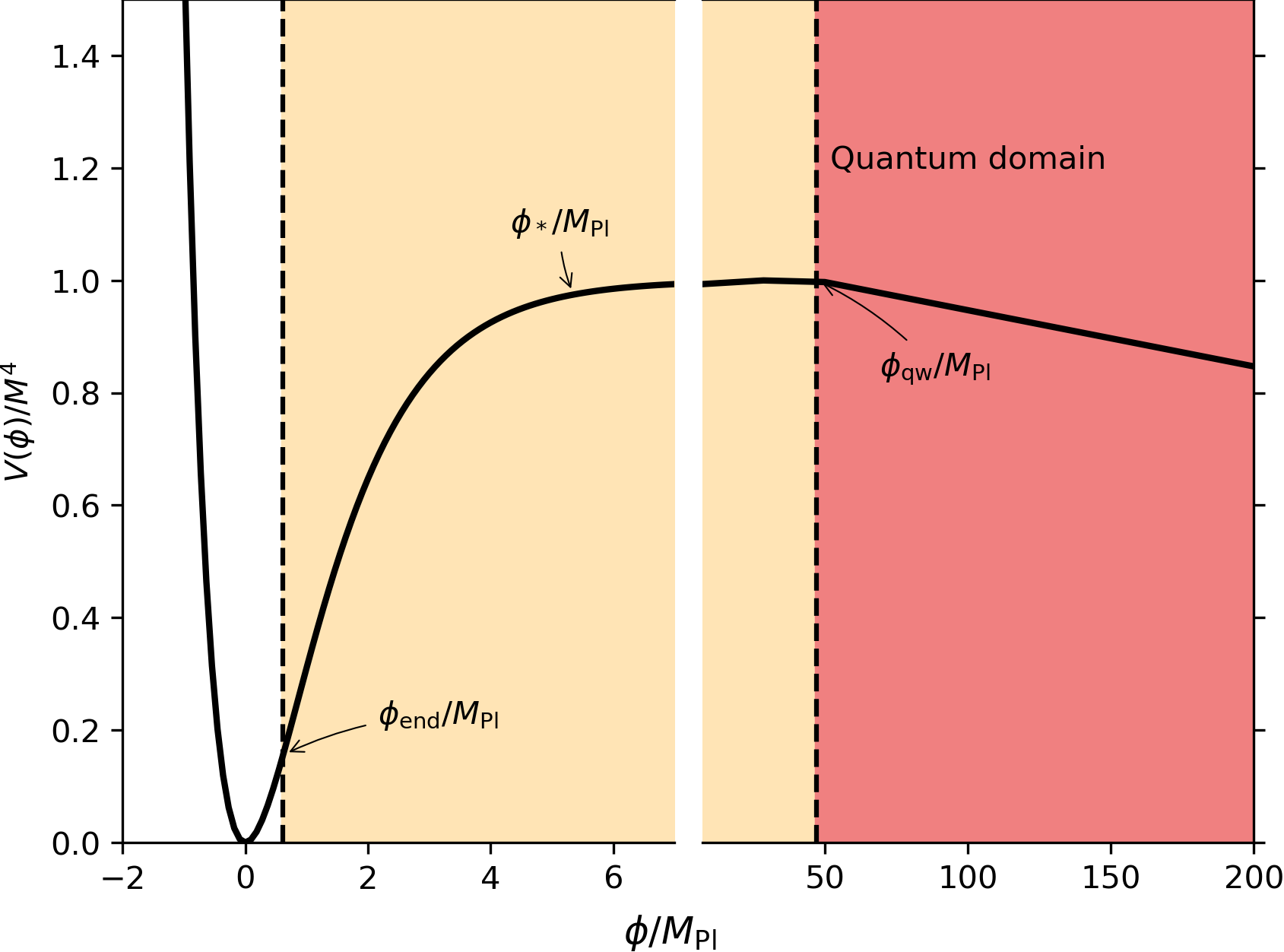
In Ref. [2], we have extended these results to the case of a tilted semi-infinite potential, an example of a positively tilted potential being represented in the following figure:
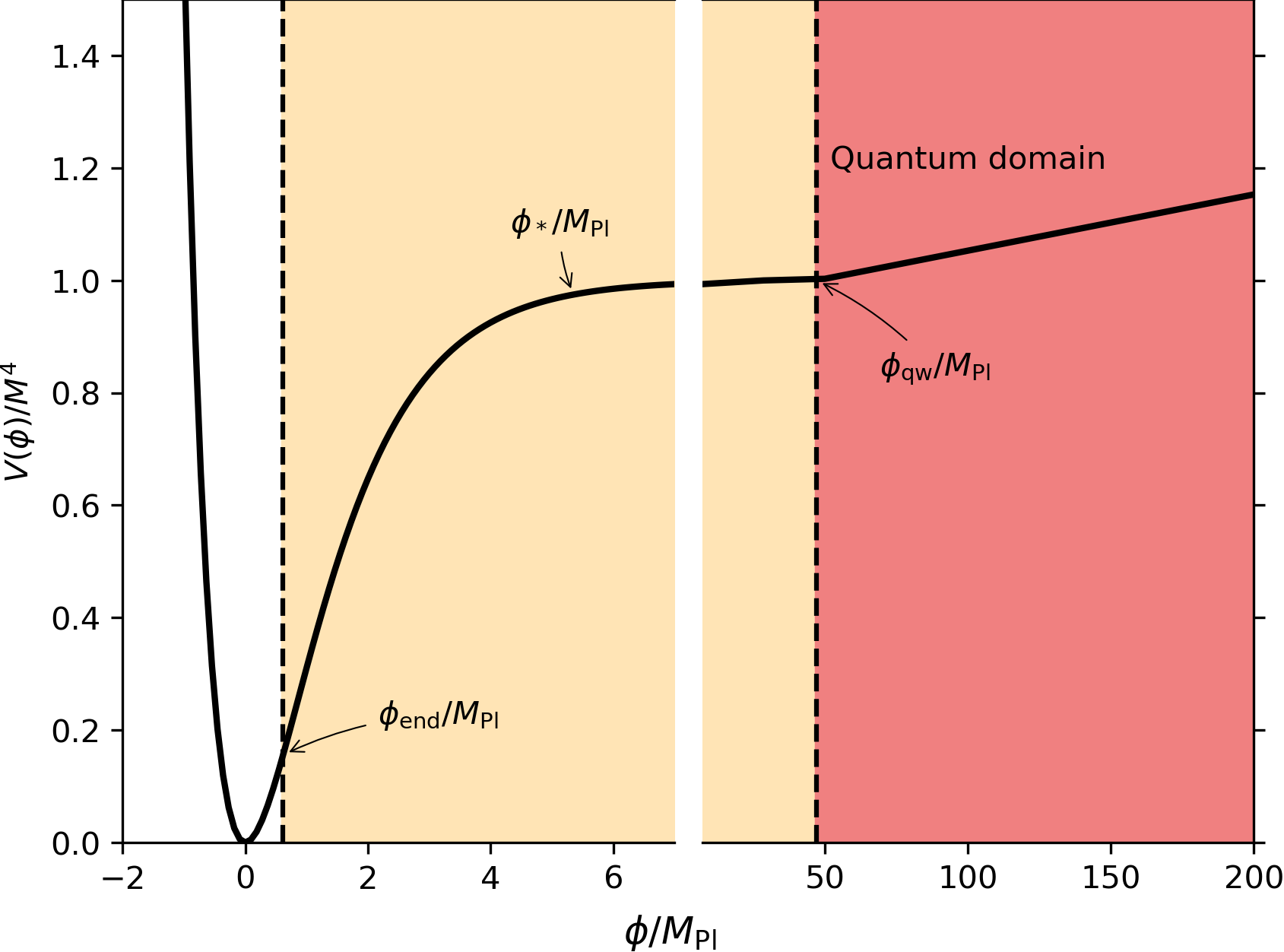
A potential tilt creates a non-vanishing friction, or drift term, in the Langevin equation (the first term on the right-hand side). The field is then driven by both the drift and the noise. The former systematically pushing the field out of the quantum diffusion domain, one may expect stochastic inflation to be tamed compared to the exactly flat semi-infinite potential. This is indeed the case. As represented in the next figure, \(P(\zeta|\phi_0)\) develops exponential tails decaying must faster than the Levy-like power-law encountered in the flat potential.
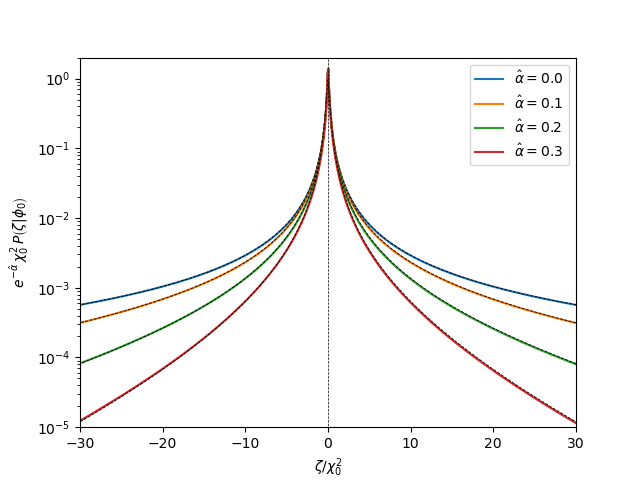
In the previous figure, the tilt of the potential is encoded in the parameter \(\hat{\alpha}\) while \(\chi_0\) is the initial field value in unit of the diffusion coefficient \(G \equiv H/(2\pi)\). For \(\hat{\alpha}\) of order unity (small tilt), it is possible to find some analytical approximation describing the tails as
\[\chi_0^2 e^{-\hat{\alpha}} P(\zeta|\phi_0) \simeq \dfrac{3}{16\sqrt{\pi}\, \hat{\alpha}^2} \left(\dfrac{\chi_0}{\sqrt{|\zeta|}}\right)^5 e^{-\hat{\alpha}^2 \frac{|\zeta|}{\chi_0^2}}.\]The dashed curves in the previous figure have been drawn from this approximate formula, they are very close to the solid curves coming from an exact numerical integration.
In the large \(\hat{\alpha}\) limit (large drift), quantum diffusion becomes sub-dominant, and we recover a classical-like behaviour. The probability distribution of the curvature fluctuations become sharply peaked at vanishing values while developing Gaussian tails:
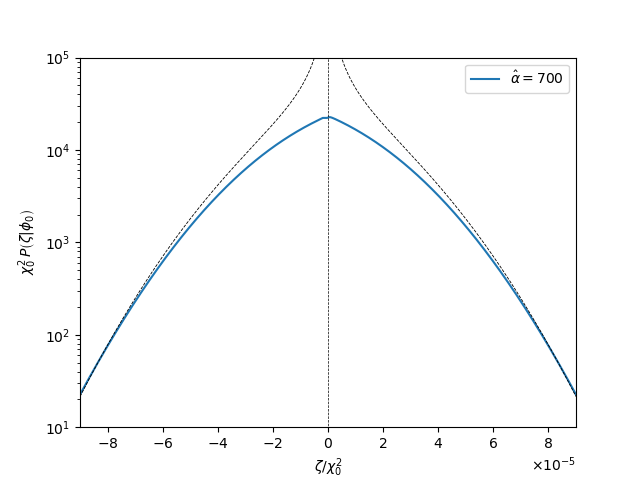
In the infinite \(\hat{\alpha}\) limit, one can indeed show that
\[\lim_{\hat{\alpha}\to \infty} P(\zeta|\phi_0) = \dfrac{1}{2 |\zeta|} e^{-2 \frac{\hat{\alpha}^3}{\chi_0^4} \zeta^2},\]which is represented as a dashed curve in the previous figure.
Another interesting aspect of the tilted semi-infinite potential is that the forward approach is regular (provided \(\hat{\alpha} \ne 0\)) and we can compare the distribution of the curvature fluctuations derived by both methods:
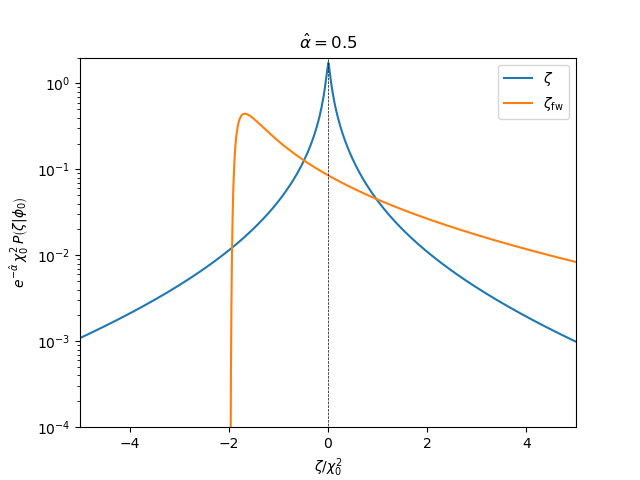
The curvature distribution in the forward picture, \(P(\zeta_\mathrm{fw}|\phi_0)\), exhibits quite an asymmetry towards positive values and vanishes for \(\zeta_\mathrm{fw}\le-1/\hat{\alpha}\). On the positive side, both distributions have exponential tails, but
\[\chi_0^2 e^{-\hat{\alpha}} P(\zeta_\mathrm{fw}|\phi_0) \simeq \dfrac{1}{\sqrt{2\pi}} \left(\dfrac{\chi_0^2}{\zeta_\mathrm{fw}}\right)^{3/2} e^{-\hat{\alpha}^2 \frac{\zeta_\mathrm{fw}}{2\chi_0^2}},\]which therefore decays twice as slow as \(P(\zeta\vert\phi_0)\) of the time-reversed approach. Contrary to the semi-classical regime, these differences between the forward and time-reversed approaches are not negligible and may have important consequences for tail-sensitive phenomena, at least when strong quantum diffusion is driving the dynamics.
Finally, a negatively tilted potential allows us to study time-reversed stochastic inflation within a simple realisation of eternal inflation. For \(\hat{\alpha}<0\), the potential looks like this:
The drift term in the Langevin equation prevents inflation to end and only large quantum fluctuations will allow for the field to exit the quantum domain. The forward approach is pathological for \(\hat{\alpha}<0\): the mean number of forward e-folds is negative while only very large values of \(\zeta_\mathrm{fw}>-1/\hat{\alpha}\) are allowed if the tilt is small and negative. In the time-reverse picture, the rescaled curvature distribution \(\chi_0^2e^{-\hat{\alpha}} P(\zeta|\phi_0)\) is unchanged and still given by the one plotted earlier. Therefore, \(\chi_0^2P(\zeta|\phi_0)\propto e^{+\hat{\alpha}}\) is now much reduced and one can also show that the Gaussian limit does not exist any more for \(\hat{\alpha}<0\). In fact, this exponential damping factor is typical of tunnelling processes and it can be related to the fact that, for \(\hat{\alpha}<0\), the survival probability after an infinite number of e-folds is non-vanishing
\[S(\infty|\phi_0) = 1 -\int_{0}^{+\infty}P_\mathrm{LT}(\Delta N_0\vert\phi_0) \mathrm{d}{\Delta N_0} = \Theta(-\hat{\alpha})\left(1-e^{-2 |\hat{\alpha}|} \right).\]In other words, for \(\hat{\alpha}\) negatively large, the survival probability approaches unity and almost all realisations are locked forever in the quantum diffusion domain. Because the time-reversed formalism only counts the realisations leaving that domain, it inherits this overall exponential damping. For \(\hat{\alpha} < 0\), the curvature distribution is actually no longer normalised to unity but to
\[\int_{-\infty}^{\infty} P(\zeta|\phi_0) \mathrm{d}\zeta = e^{-2|\hat{\alpha}|}.\]Therefore, the time-reversed formalism automatically encompasses a measure which is given by \(1-S(\infty)\), which is quite satisfactory. Indeed, while the statistics of cosmological observables is only performed in the subset of possibilities leading to the Friedmann-Lemaître decelerating models, the overall probability to measure them remains weighted by the likeliness of inflation to end.